Despite the S&P500 being only 24 points from all time highs, AAII investor bullish sentiment has reached unusually low levels. Fund flow data indicates that over the past 2 weeks a lot of money has left US equity ETFs and flowed into developed international and emerging market ETFs. The Fast Pitch blog indicated recently that fund manager US equity allocation is currently at a 9 year low.
From a contrarian perspective one must view this as positive. With cash balances of the top companies in the S&P500 at record levels, corporate tax reform on the horizon combined with sound corporate and economic fundamentals, it makes sense to be a buyer of US equities. I think the majority of investors are being distracted by the negative media and the recent Trump political drama.
Showing posts with label stock market. Show all posts
Sunday, May 21, 2017
Nasdaq 2017 = Dow Jones Industrial Average 1950s? Ultra bull market ahead?
Looking back it wasn't surprising that the US stock market would enter a correction at the Nasdaq 5000 range. This was the previous year 2000 top (~5200). Breaking through this level required more conviction on behalf of the market as it signified the Nasdaq was finally leaving the dot.com bubble top behind it. Market watchers have been focusing on Dow 20000 and S&P500 2400 but I think the Nasdaq is the index to watch.
After the 1929 top, the Dow finally reached new ATHs in the early 1950s AFTER which a 18 year bull market followed until concluding in 1968. The post 2000 Nasdaq has a very similar chart to the post 1929 Dow. Some differences being that consolidation in the Nasdaq post 2000 was more constructive and shorter in duration than Dow consolidation during the Great Depression. From absolute top to bottom the Nasdaq corrected less than the Dow and reached new ATHs sooner. One can suggest that the modern Nasdaq has shown more resilience than the 1930s Dow. If the Nasdaq follows a similar pattern of Dow 1950 we can expect a long and powerful bull market ahead.
Labels:
1929,
breakout,
bubble,
bull market,
bullish,
nasdaq,
stock,
stock market,
tech boom,
tech stocks,
technical,
technology
Monday, September 16, 2013
Small Cap Stocks To Lead Long Term
Everyone knows that small cap stocks are the canary-in-the-coal mine for the economy. One can assess the strength of the overall global economy based on the performance of small cap stocks relative to large cap stocks. They tend to outperform when business conditions are good (i.e. consumers are spending, fear is moderate, lenders are lending, interest rates are low, etc.) During bear markets, small cap stocks underperform. During bull markets, they outperform. We are currently witnessing the beginning of long term small cap stock outperformance.
From a technical perspective, IWM which tracks the Russell 2000 small cap index, has broken out of a large ascending triangle pattern and is on its way to new highs. We're just getting started...
Sunday, September 15, 2013
Akamai breaks out. Tech leadership expands.
What began as market leadership in biotechnology stocks quickly spread to internet stocks and is now perpetuating in the NASDAQ 100 mega cap stocks. We are entering a period of broad based tech market leadership which may continue for the duration of this bull market that began in 2009. It is important to note that both the biotechnology and the internet index has doubled in a 2 year time frame.
Friday, July 26, 2013
The S&P TSX Composite Index Will See New Highs In The Near Future
After the 1973-74 bear market, the TSE 300 (now the S&P TSX Composite Index) underwent a multiyear period of price consolidation prior to its breakout in 1978. Do you see the similarities between now and then? Note how bad the following 1982-83 bear market that succeeded the breakout was. The early 80s recession was a very difficult time for Canada.
Friday, August 20, 2010
Mid-Term Election Year
This year is a much talked about mid-term election year. As we all know, North American equity markets usually post a major multiyear low during the later part of a mid-term election year.
Have we seen the lows for the year or will the market move down sharply through September as it does in a typical mid-term election year? It really could go either way at this point. From a technical perspective, this year has played out in classic fashion. Support has held well on the DOW at ~10 000, dipping slightly below 9700 in July. If this year follows the mid-term election pattern, we could see the DOW make a low at ~9000, at which there is strong technical support. So was the July low, the multiyear low for the markets or are we going to fall into correction again and make new lows through September?
The problem with this mid-term election year is that it is the primary focus of the media more so than any other mid-term election year. Every stock analyst is referring to this year as a mid-term election year and drawing attention to the fact that a correction could be around the corner. Pessimism is elevated, the VIX is elevated but wavering, the Put/Call ratio is elevated, 10-year treasury yeilds are at record lows, bonds are overbought and there is still a ton of cash sitting on the sidelines.
The real question is whether or not there are enough sellers left to push the market to a new low.
Thursday, August 19, 2010
Where is the market headed?

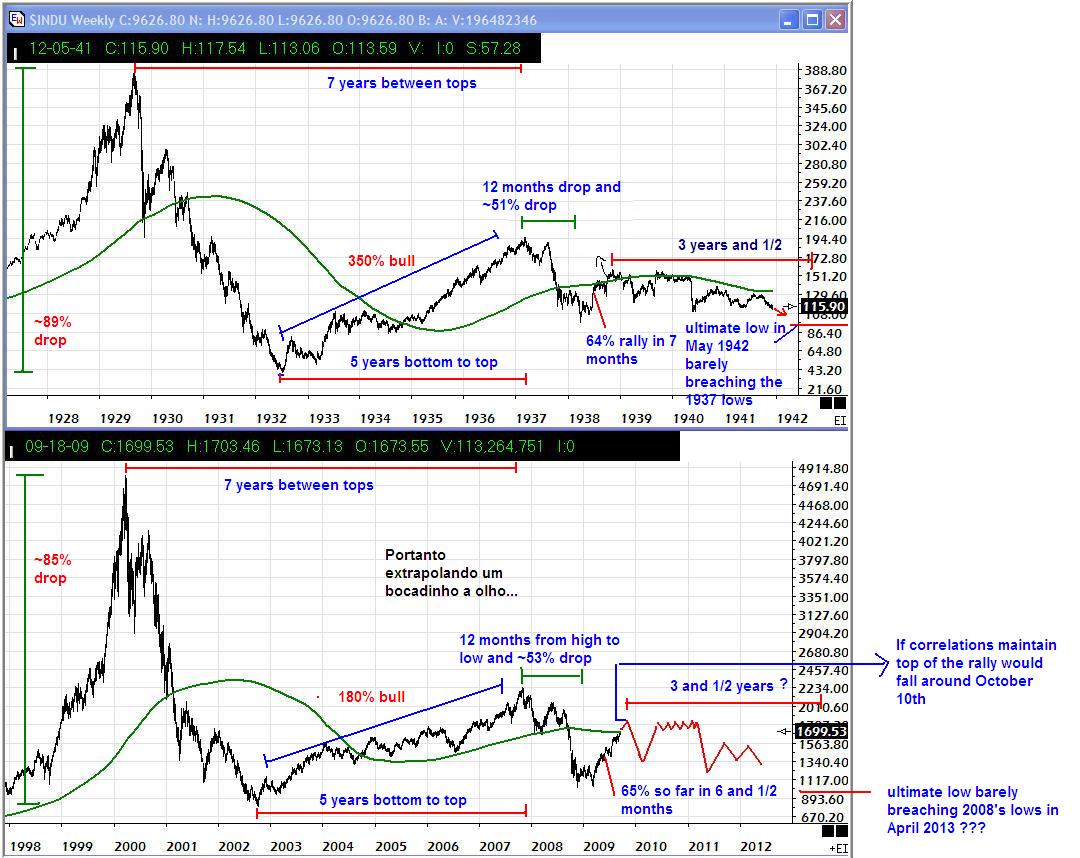
It is remarkable how much the 1930s DOW chart resembles the NASDAQ 2000s chart. The boom and bust nature of the roaring 20s and the technology boom of the 80s and 90s illustrates the fact that human psychology remains at least one constant in the stock market.
From their inception, both the early DOW and NASDAQ experienced years of uninterrupted growth before making their final parabolic moves and then subsequent crashes. The DOW took 12 years to fully "correct" before resuming a long term uptrend that began in 1942. We are 10 years into the NASDAQ's long term period of price consolidation. The real question is how much more time is required for the NASDAQ to fully consolidate and are we headed lower first?
One striking difference between these two charts is the magnitute of their second bull run after their massive crashes. After correcting 89% from its peak, the DOW broke out of a 3 year base pattern and moved up 380%. The DOW subsequently came back to test the 100 point level in 1938 and one final time in 1942 after which a long term uptrend resumed. The NASDAQ, however, moved up a mere 180% after its crash only to break support and retest its crash lows in 2009.
What does this mean? After a significant 380% rebound, it took two retests of the 1935 break out level support at ~100 to wash out all weak investors and the DOW to finally break out in 1942 and never look back. With respect to the NASDAQ, all of the weak holders were washed out in 2008 by a near retest of the 2002 crash lows. A second retest of the 2002 crash lows is unlikely. Support is more likely to hold near 2000 points or slightly below this level. The chart above suggests the NASDAQ will lack direction and drift to the old lows. I don't think so but anything is possible.
So perhaps it takes a year or two more before the NASDAQ defines itself as the true market leader once again. What's more important is the long term uptrend that will follow. In approximately 60 years, the DOW surged 1000% or two exponential steps. It stood at 100 points during the 1940s, moved up by one exponential step to 1000 points during the 1970s, and subsequently moved by another exponential step to 10 000 points by the year 2000. Each exponential move required approximately 20 years to complete, followed by a 10 period of price consolidation.
The NASDAQ currently sits at ~2000 points. By 2020 the NASDAQ should make one exponential step to 20 000 points and then enter a period of price consolitation during the 2030s. The uptrend will then resume in approximately 2040 with the NASDAQ reaching a remarkable 200 000 points, a second exponential step, by 2060 give or take a few years.
What's more interesting is where the other indicies will be given these time frames. Following the same trend, the S&P 500 and DOW shoud reach 10 000 and 100 000 points respectively by 2030. The following exponential step would bring the S&P 500 to 10 000 points and the DOW to a whopping 1 million points by the year 2060.
Sounds silly right? Imagine, how many people would have believed you if in 1942 with the Great Depression fresh in the entire world's mind, you made a prediction that the DOW which then stood at a mere 100 points, would reach 10 000 points by the year 2000?
This is the nature of exponential growth.
Labels:
1920s,
dow,
exponential,
great depression,
growth,
nasdaq,
stock market,
tech boom
Subscribe to:
Comments (Atom)


